

EIC Accelerator: Building Europe’s Next Deeptech Champions Together
During the EIC Accelerator Info Day 2026, held on June 15th at Bpifrance’s in Paris, European innovation leaders, national innovation agencies and deeptech entrepreneurs gathered to discuss one of Europe’s key challenges: how to transform breakthrough innovations into global industrial champions. The event highlighted a shared conviction that Europe’s future competitiveness will depend not only
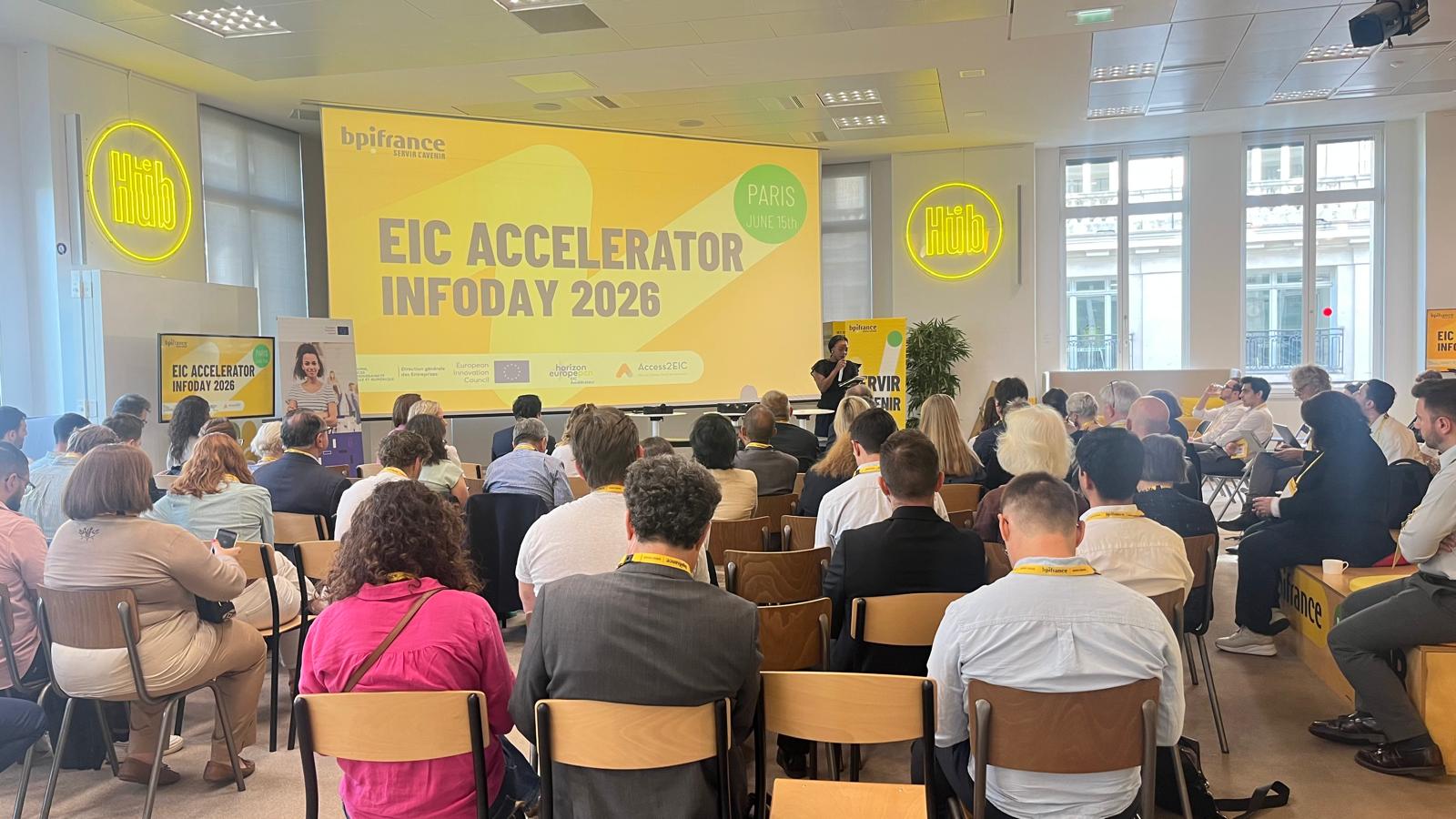
As discussions on the future of Horizon Europe intensify, increasing attention is being given to the scale-up challenge. While Europe is home to cutting-edge innovations in fields such as quantum computing, artificial intelligence and advanced materials, turning these technological advances into market-leading businesses remains a critical priority. In this context, the European Innovation Council (EIC) Accelerator and national innovation agencies are playing complementary roles, providing the financial, strategic and ecosystem support needed to build Europe’s next generation of deeptech champions.
The scale-up challenge
For Michiel Scheffer, President of the EIC Board, Europe’s main challenge is no longer startup creation: “The biggest challenge today is no longer creating startups. It is helping them scale.” Access to growth capital, international markets, public procurement opportunities and industrial partnerships remain critical if Europe wants to retain and grow its most promising innovators.
Scheffer also highlights the importance of organizations such as Bpifrance in preparing companies for European programmes and sharing best practices between beneficiaries: “National policies and organizations such as Bpifrance must remain aligned with the EIC.”
From Innovation to Scale-Up: A Continuous Journey
For Georges-Olivier Reymond, CEO of quantum computing pioneer Pasqal, innovation support should be viewed as a long-term pathway rather than a single funding opportunity: “They have programmes that are deployed at different moments in a company’s life cycle. Bpifrance and the EIC are two key institutions for deeptech development that complement each other, and companies should leverage both.”
His experience highlights a common reality for deeptech entrepreneurs: transforming cutting-edge research into industrial success requires different forms of support at different stages, from early validation to international expansion. The EIC Accelerator fills a critical gap by providing substantial funding and investment support to high-risk, high-potential startups and SMEs seeking to scale out breakthrough innovations.
The strength of Europe’s innovation ecosystems
According to Denisa Perrin, Head of Unit EIC Accelerator, the EIC’s success is closely tied to the quality of national and regional ecosystems. “The EIC does not function without national and regional partners.”
Many EIC beneficiaries have first received support through national funding programmes, incubators, accelerators, or innovation agencies. These structures help companies advance their technologies and prepare for highly competitive European funding opportunities. According to the Head of Unit EIC Accelerator: “We see companies that have first gone through national pathways. This close cooperation allows us to build on well-established national systems.”
Beyond funding, the EIC also plays a strategic role in identifying the technologies that could shape Europe’s future, through partners who “can detect technological signals both qualitatively and quantitatively”, adds Denisa Perrin.
A virtuous circle between Europe and Member States
National innovation agencies such as Bpifrance, Enterprise Ireland and their counterparts across Europe play a crucial role in identifying promising companies and helping them prepare for European programmes.
James Walsh of Enterprise Ireland describes the relationship between the EIC and national agencies as a continuous exchange: “We support companies from their earliest stages all the way through their scale-up journey.”
Innovation agencies bring field expertise and national priorities, while the EIC contributes to a broader European vision and strategic direction. According to the representative of the EIC Program Committee: “In the end, it creates a virtuous circle.”
Looking Ahead: Horizon Europe 2028-2034
As Europe prepares the next generation of research and innovation programmes, one priority is becoming increasingly clear: supporting breakthrough technologies beyond their creation and towards industrial leadership.
The objective is no longer simply to fund innovation. It is to build globally competitive deep-tech companies capable of creating strategic value, strengthening European sovereignty, and driving future economic growth.
The EIC Accelerator, together with national innovation ecosystems, is demonstrating that Europe’s future champions will emerge not from isolated initiatives, but from a coordinated effort spanning regional, national and European levels.
Testimonials were collected during the EIC Infoday 2026 event and are available through a series of dedicated video capsules, click here to see them.
Related
Trending
From Reindustrialisation to Exports: The new momentum of France’s Defence Industry
Against a backdrop of rising geopolitical tensions and accelerating European rearmament, France’s...
Foreign Plunge! How Hexagone Manufacture Found International Success In Robotic Pool Solutions
Hexagone Manufacture, a French specialist in solutions for private and public swimming...

25 years of Averroès ! Bpifrance doubles down on Africa’s private sector growth
As the Averroès Forum opens in Nairobi on May 12 alongside the...